DiskBoss Logo

Selecting Disks Using Macro Commands

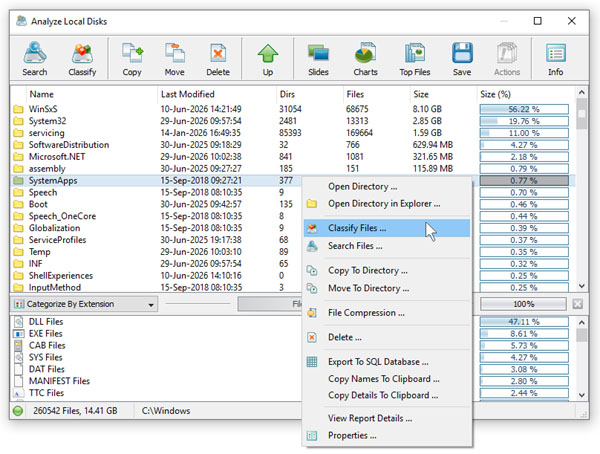
Normally, DiskBoss disk analysis and file search commands process a pre-defined set of input disks, directories and/or network shares, but sometimes it may be required to dynamically select disks to be analyzed depending on the configuration of the analyzed host computer.

For example, let's assume that the user needs to analyze a number of internal hard disks and a number of external hard drives with external hard disk drives sometimes connected and sometimes not depending on each specific situation. In such cases, it is not possible to pre-configure an analysis operation to process a pre-defined set of input disks and such operations should be configured dynamically according to the current configuration of the host computer.

In order to enable dynamic configuration of disk space analysis, file classification and file search operations, DiskBoss provides a number of macro commands allowing one to automatically select which disks to process according to the current configuration of the host computer. The following macro commands may be added instead of input directories to disk space analysis, file classification, duplicate files detection and file search commands:

  • $ALL_LOCAL_DISKS - this macro command inserts all internal hard disks to the list of directories that should be processed.
  • $ALL_EXTERNAL_DISKS - this macro command inserts all external hard disks to the list of directories that should be processed.
  • $ALL_NETWORK_DISKS - this macro command inserts all mapped network drives to the list of directories that should be processed.
  • $ADD_NETWORK_SHARES <Host Name or IP Address> - this macro command inserts all network shares accessible in a server or NAS storage device identified by the specified host name or IP address.
  • $ADD_DISK_LABEL <Label> - this macro command inserts all disks containing the specified disk label to the list of directories that should be processed.
  • $DEL_DISK_LABEL <Label> - this macro command removes all disks containing the specified disk label from the list of directories that should be processed. For example, this macro command may be used with the $ALL_LOCAL_DISKS macro to remove the system disk or other special disks that should be excluded from the analysis operation.
  • $DEL_DISK_LETTER <Letter> - this macro command removes the specified disk letter from the list of directories that should be processed. For example, this macro command may be used with the $ALL_LOCAL_DISKS macro to remove the system disk from the analysis operation.

In addition, these macro commands may be used to pre-configure disk space analysis, file classification, duplicate files detection and/or file search commands to be executed on a number of different servers when each server has a different set of hard disks to be analyzed. A set of disk analysis commands may be pre-configured and tested on a single server and then broadcasted to a number of DiskBoss Servers through the network using the DiskBoss Server configuration sync feature.

DiskBoss News

6-May-2026

DiskBoss v16.7 add support for new file types to the built-in file classification plug-ins, improves the file classification results dialog and improves the file classification plug-ins designer. In addition, the new product version adds support for new file search rules, improves the file search rules dialog, improves the DiskBoss command line utility and fixes a number of bugs.

7-Apr-2026

DiskBoss v16.6 redesigns the PDF and HTML disk space analysis reports, improves support for conditional, rule-based disk space analysis operations allowing one to analyze specific types of files according to the user-specified rules and conditions. In addition, the new product version improves the main DiskBoss GUI application and fixes a number of bugs.

More News